
A literary holodeck for
solo tabletop RPGs
Procedural systems build the skeleton — maps, encounters, loot. An AI Game Master breathes life into every interaction. Real tools keep it all honest. Here's the whole machine.
Your sketch becomes a living world
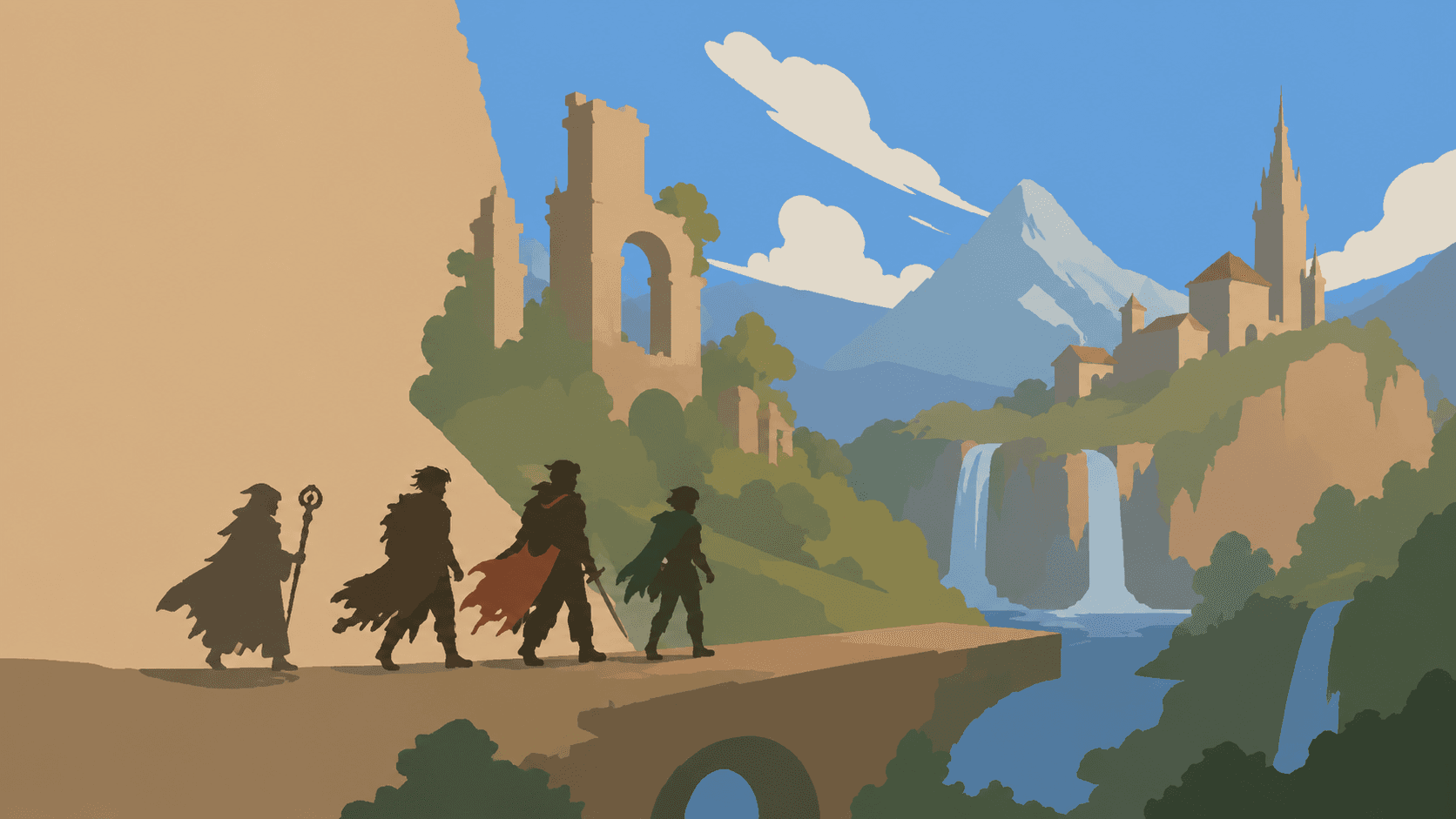
You provide structure — sketch it by hand in the workshop, or answer a few questions and the AI drafts a playable ruleset, world and story for you. The procedural engine fills in the bones; the AI gives it a voice, a mood, and consequences. The same picture, materialising from blueprint into reality.
Every turn runs through real tools
Generative AI is a brilliant storyteller and a terrible accountant. So it never guesses the numbers — it calls deterministic tools for dice, checks and state, then narrates whatever actually happened.
You act
Say what your character does, in plain language.
GM sets stakes
Frames the situation and calls for the right check.
Tools roll
Real dice & rules resolve it — no fudging.
State updates
Inventory, HP, position and memory all change.
GM narrates
Describes the real outcome, dramatically.
Procgen makes the what. AI makes the why.
Seeded random generation creates structure you can trust to be consistent. The AI never has to invent stats on the spot — it gets to do what it's best at: meaning, voice and drama.
Three layers you can mix and share
Everything you make is modular. Snap any ruleset under any world under any story — yours or the community's. Publish what you build, or fork someone else's and remix it.
Rulesets
Attributes, skills, combat maths, currency and dice conventions. Start from the 5e-Compatible SRD, or define a homebrew system from scratch.
Worlds
Terrains and a hex map, factions and their relationships, a bestiary, and a linked lore wiki — deities, cultures, history — that anyone can browse once you publish.
Stories
A narrative arc, beats, plot threads and faction pressures that hook into world state. The skeleton the AI fleshes out as you play.
The world keeps honest books
Tracked by tools
Anything that should be exact, is. The AI reads and writes this state through tools — it can't quietly forget your gold or your wounds.
Persistent memory
Every session writes to a durable memory of the world. NPCs remember what you did to them; threats escalate while you're away; the bridge you burned stays burned.
- NPC relationships shift from allied to hostile and back.
- Quest flags & world state survive across months of play.
- Pick up exactly where you left off — Day 12, hex 04,03, mid-scene.
Recorded at creation
When the GM invents something — a ring, a goblin, a grudge — its mechanics are recorded the moment it enters the world, and every later use resolves from that record. Invented once, true forever.
- Items keep the stats they were found with.
- A spawned goblin's rolled HP is its HP forever.
- No re-rolls, no retcons.
Beats that fire when you earn them
A story here isn't a script — it's a spine. Authors write beats (the dramatic escalation points) and plot threads (stakes, clues, outcomes), then attach watchers: condition → effect rules that listen to your play. And the journal stays spoiler-safe — you only ever see what you've earned.
Deterministic watchers
Machine-checkable conditions the engine evaluates every turn — exact, instant and free.
- day ≥ 3 — time has passed.
- flag bridge_burned — a fact was set.
- clues ≥ 2/4 — a counter crossed its line.
AI judgment — moment detection
Some moments no flag can capture. The GM carries a short watchlist and sets the flag the instant the moment happens in the fiction — in whatever words you chose.
- "The party gained the witch's trust."
- "They publicly sided with the cult."
- No trigger phrases. No dialogue trees.
“the party gained the witch’s trust”
No fudged fights
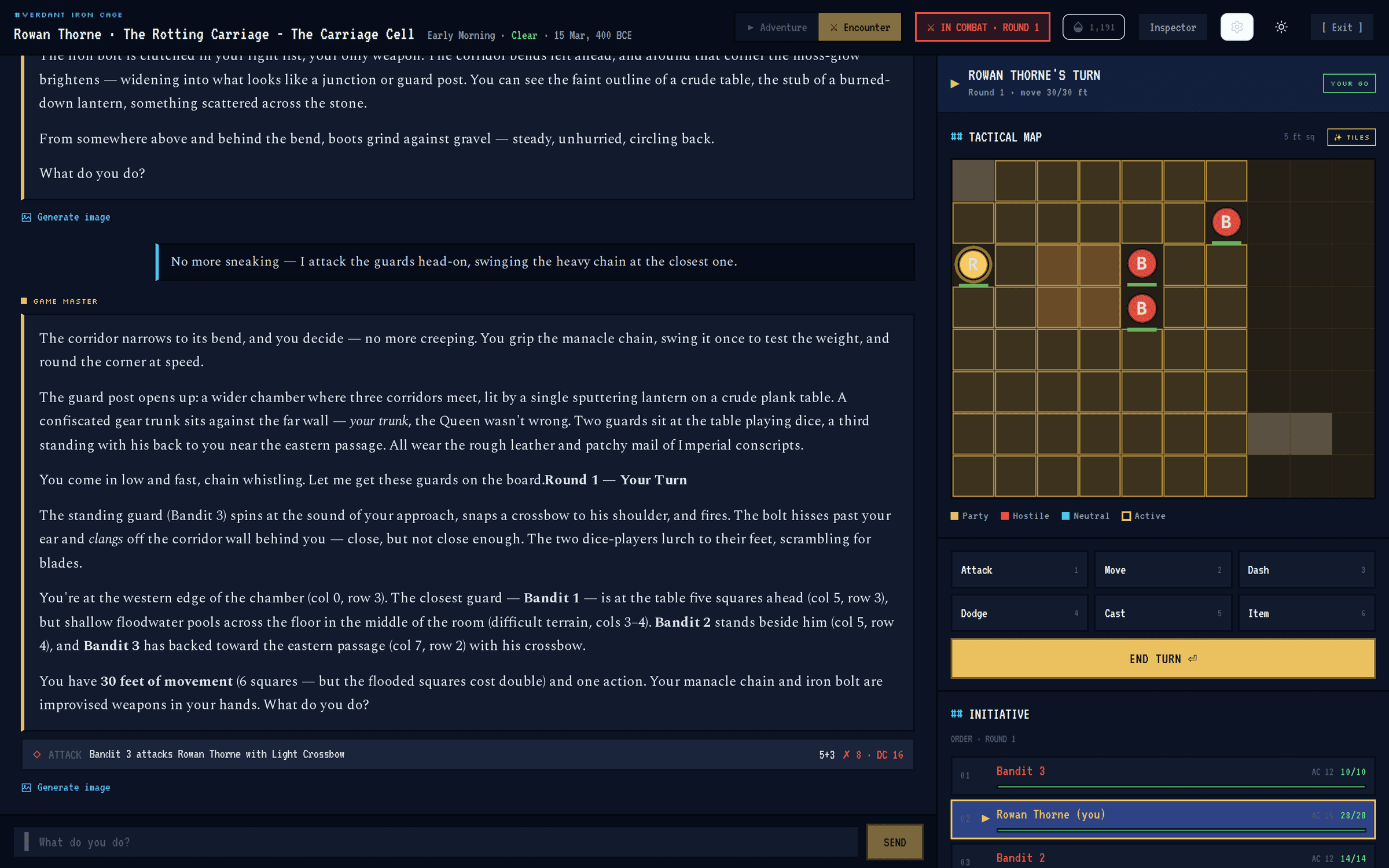
A fight is never hand-waved. The scene snaps onto a pixel-art battle map — real positions, movement and range, six-second rounds. You choose your moves; the system resolves every NPC's turn deterministically, with the same dice and rules as everything else.
One world, every scale
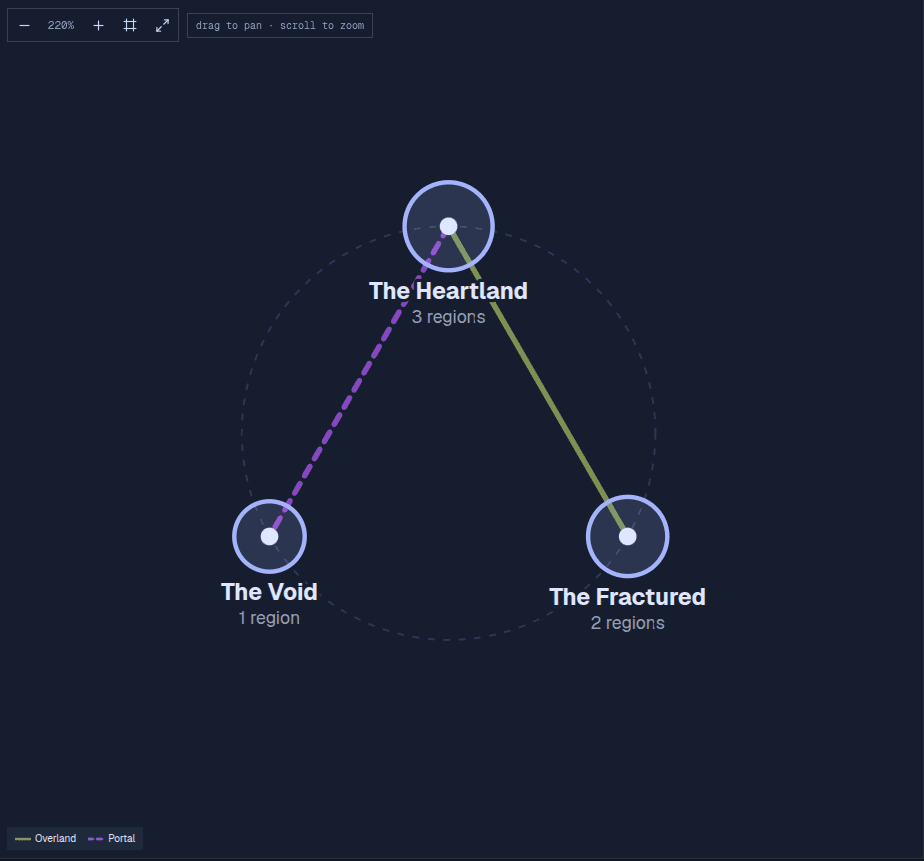
A journey moves between the world's maps without a seam — galaxy to street, chart to room — and every place you return to is exactly as you left it.
The overworld
Cross a procedurally generated wilderness one hex at a time — terrain sets the pace, and weather and encounters find you on the road.
Interiors
Step off the map into dungeons, towers and towns generated room by room — consistent every time you come back, down to the loot you left behind.
The open sea
Board or charter a vessel and its deck becomes your scene — sail hex to hex and region to region, and the whole ship travels with you.
It doesn't have to be d20 fantasy
The rules engine is fully swappable. We ship a 5e-Compatible ruleset built on the SRD 5.1 so you can start instantly — but the resolution maths, stats and dice are all yours to redefine.
See it run for yourself
Jump into a community world in one click, or sketch your own and watch the AI bring it to life.